
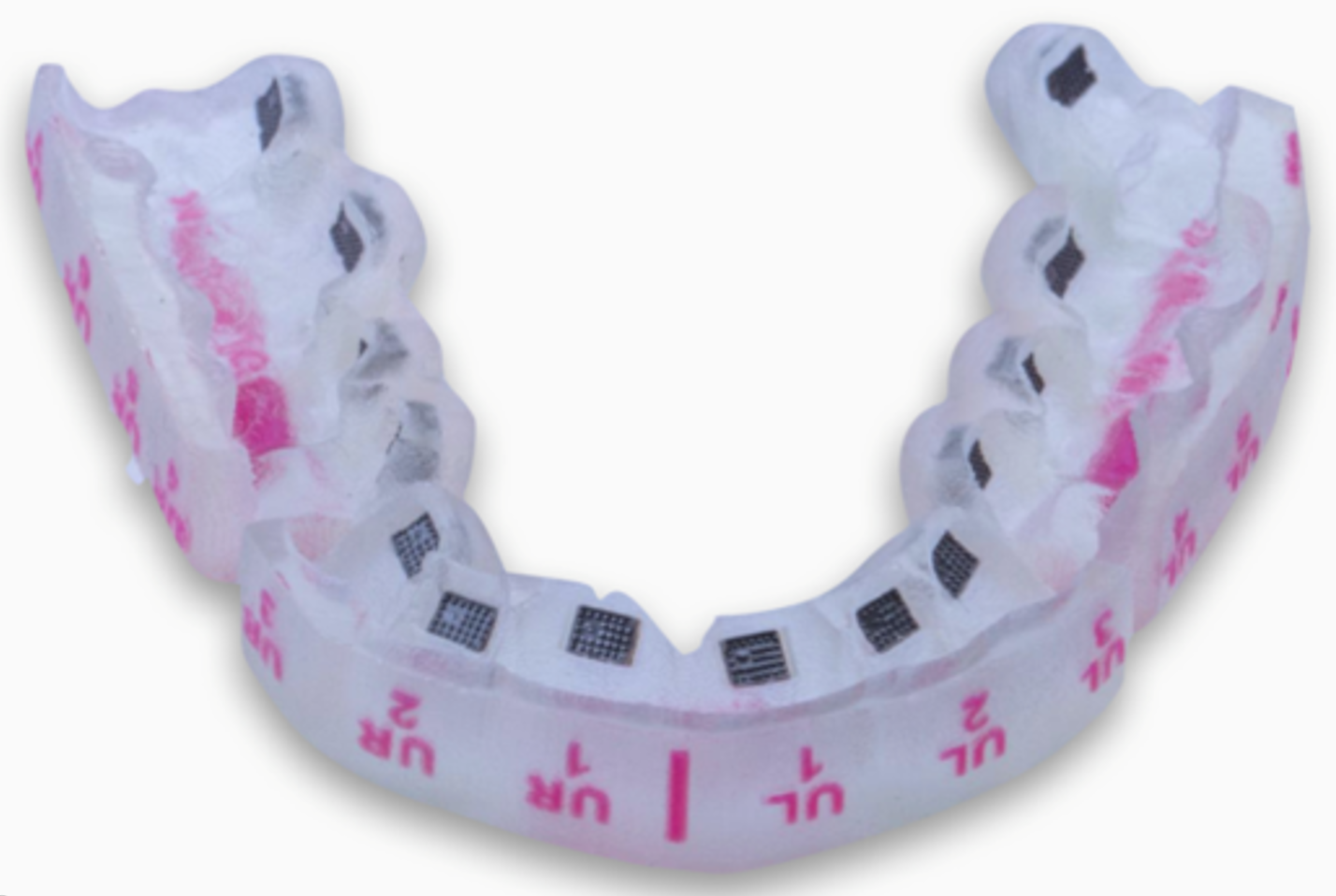
When most people think about braces, they picture brackets attached to teeth and wires connecting them. What patients rarely think about is one of the most important factors in how treatment unfolds: exactly where each bracket is positioned on each tooth.
Even small differences in bracket placement can affect how a tooth moves. A bracket positioned slightly too high, too low, or at the wrong angle may cause a tooth to move differently than planned, requiring the orthodontist to reposition it or make corrective bends in the wire. InSmile Braces takes a different approach by planning bracket positions digitally before treatment begins and transferring those positions onto the teeth using custom 3D-printed bonding trays.
Traditional braces work by attaching brackets to teeth and connecting them with an archwire. As the wire applies forces through the brackets, the teeth gradually move into alignment. The position of each bracket plays a direct role in determining how those forces are delivered.
In conventional direct bonding, the orthodontist places each bracket individually onto the tooth, using anatomical landmarks, measurements, and clinical judgment to determine its position. This technique has been used successfully for decades, and experienced orthodontists can achieve precise results with it. However, the orthodontist is making those placement decisions while working inside a patient's mouth, where visibility and access are naturally limited.
As treatment progresses, brackets may need to be repositioned and wires may need additional bends to fine-tune tooth positions. These are normal parts of conventional treatment, but they illustrate why getting bracket placement right from the beginning has value.
InSmile incorporates bracket positioning into the digital treatment planning process. Rather than deciding where each bracket goes during the bonding appointment, the bracket position is designed in an optimal position on a computer before treatment begins.
The process starts with a digital scan of the patient's teeth. Using specialized InSmile software, a customized digital treatment plan is developed to map out the intended tooth movements and final positions. The brackets are then digitally positioned in an ideal position to coordinate with the customized Smartwire design. This allows much of the treatment planning and bracket positioning to be completed before the braces are ever placed.
InSmile brackets are placed on the lingual surfaces of the teeth, the side that faces the tongue, rather than the visible front surfaces. These surfaces are often more irregular in shape and significantly more difficult to access and see directly. Accurate bracket placement using traditional direct bonding techniques is particularly challenging in this location.
Digital planning and indirect bonding help address these challenges. By establishing bracket positions on a computer model, the orthodontist can evaluate placement with full visibility before the appointment begins. A custom tray then helps accurately transfer those planned positions to the teeth, reducing the need to position each bracket individually in the difficult-to-access areas behind the teeth.
Once the bracket positions are digitally planned, the next step is transferring those positions onto the patient's actual teeth. This is where indirect bonding comes in.
With InSmile Braces, custom indirect bonding trays are designed digitally and manufactured using 3D printing technology. Each tray is made specifically for the patient's teeth and holds the brackets in their planned positions. During the bonding appointment, the tray fits over the teeth and guides the brackets into their intended locations. Once the brackets are bonded and the adhesive sets, the tray is removed, leaving the brackets attached to the teeth in their planned positions.
The result is a more standardized and streamlined bonding process. Rather than individually positioning each bracket on the difficult-to-access surfaces behind the teeth, the clinical team uses the custom tray to guide the brackets into their planned positions. This simplifies the procedure and can make the bonding appointment more efficient, while helping ensure that the brackets are placed consistently with the digital treatment plan.
Accurate bracket placement is especially important in the InSmile system because the brackets and Smartwires are designed as a coordinated set. The orthodontist's digital treatment plan establishes the intended tooth positions, the brackets are positioned to support those movements, and the Smartwires are customized to deliver forces based on that same plan.
Accurate bracket placement helps ensure that the physical appliances function as closely as possible to their digitally planned positions. This coordination between the digital treatment plan, bracket positioning, and customized Smartwires is one of the defining features of the InSmile system.
Accurate placement may also help reduce the need for some corrective adjustments during treatment. That said, orthodontic treatment is always a biological process. Teeth do not move exactly as predicted in every case, and bracket repositioning or additional refinements may still be necessary. Digital technology improves planning consistency and reduces variability, but it does not replace clinical judgment.
For patients, this technology means that your orthodontist arrives at your bonding appointment with a detailed plan already approved, rather than determining bracket positions individually during the appointment. Bracket positions have been carefully planned in advance, coordinated with the Smartwires that will guide your teeth, and designed to be transferred accurately using custom trays made specifically for your teeth.
Combined with the fact that InSmile brackets are placed behind the teeth and are virtually invisible when smiling, this digitally customized approach offers patients the benefits of precise orthodontic planning with the discretion of hidden braces.