
One of the most distinctive parts of InSmile Braces is the Smartwire. While most patients focus on the brackets attached to their teeth, orthodontists often think of the wire as the true engine of tooth movement. The wire is what delivers the light forces that gradually guide teeth into their ideal positions. So what makes an InSmile Smartwire different from the wires used in traditional braces? To answer that question, it helps to first understand how modern orthodontic wires work.
Nearly every orthodontic patient today begins treatment with nickel titanium (NiTi) archwires. Nickel titanium is a special shape memory alloy that has the remarkable ability to return to a pre-programmed shape after being bent or deformed. Bend it, and it returns to its original form. When a NiTi wire is placed into crooked teeth, the wire is forced out of its ideal shape. As it attempts to return to its original form, it applies light, continuous forces to the teeth, gradually moving them into better alignment.
This is one of the reasons modern orthodontics is far more comfortable than it was decades ago. Nickel titanium wires deliver consistent, gentle forces over long periods of time instead of relying on the heavy, intermittent forces that older wire materials required.
Although nickel titanium wires are incredibly effective, there is an important limitation. Traditional orthodontic wires are manufactured in standard arch shapes, which means that every patient starts with essentially the same wire shape, regardless of whether their smile is narrow, broad, crowded, or spaced.
During the early stages of treatment, these stock wires work very well because their primary job is to begin aligning the teeth. However, as treatment progresses and greater precision is needed, orthodontists often transition to stainless steel wires. Unlike nickel titanium, stainless steel wires can be manually bent and customized. Orthodontists place bends into the wire to fine-tune individual tooth positions and bite relationships, then observe how the teeth respond and make further adjustments at future appointments.
This process has been used successfully for decades, but it requires considerable skill, significant chair time, and multiple adjustment appointments to achieve a finished result.
InSmile Braces takes a fundamentally different approach. Instead of starting with a standard NiTi wire, transitioning to stainless steel wires, and gradually modifying the stainless steel wires throughout treatment, InSmile Smartwires are designed specifically for your individual treatment plan from the very beginning.
The process starts with a digital scan of your teeth. Your orthodontist uses specialized InSmile software to move your teeth into their ideal positions on a computer, creating a complete digital treatment plan. Once the final result is approved, the Smartwires are designed around that plan. Rather than using a stock arch form, each Smartwire is customized to guide your teeth toward the exact positions your orthodontist planned digitally. In other words, the wire is designed for your smile, not for the average patient.
Like traditional nickel titanium wires, InSmile Smartwires are made from shape memory nickel titanium. The difference is that the programmed shape of the wire is customized to your individual treatment plan rather than a stock arch form. When the Smartwire is placed into your mouth, your teeth are typically not yet in their planned positions. As the wire attempts to return to its customized shape, it delivers light, continuous forces that move the teeth toward the digitally designed result. Because the wire is based on your specific treatment plan, the Smartwire itself carries much of the information needed to guide tooth movement, resulting in precision that traditional stock wires simply cannot provide.
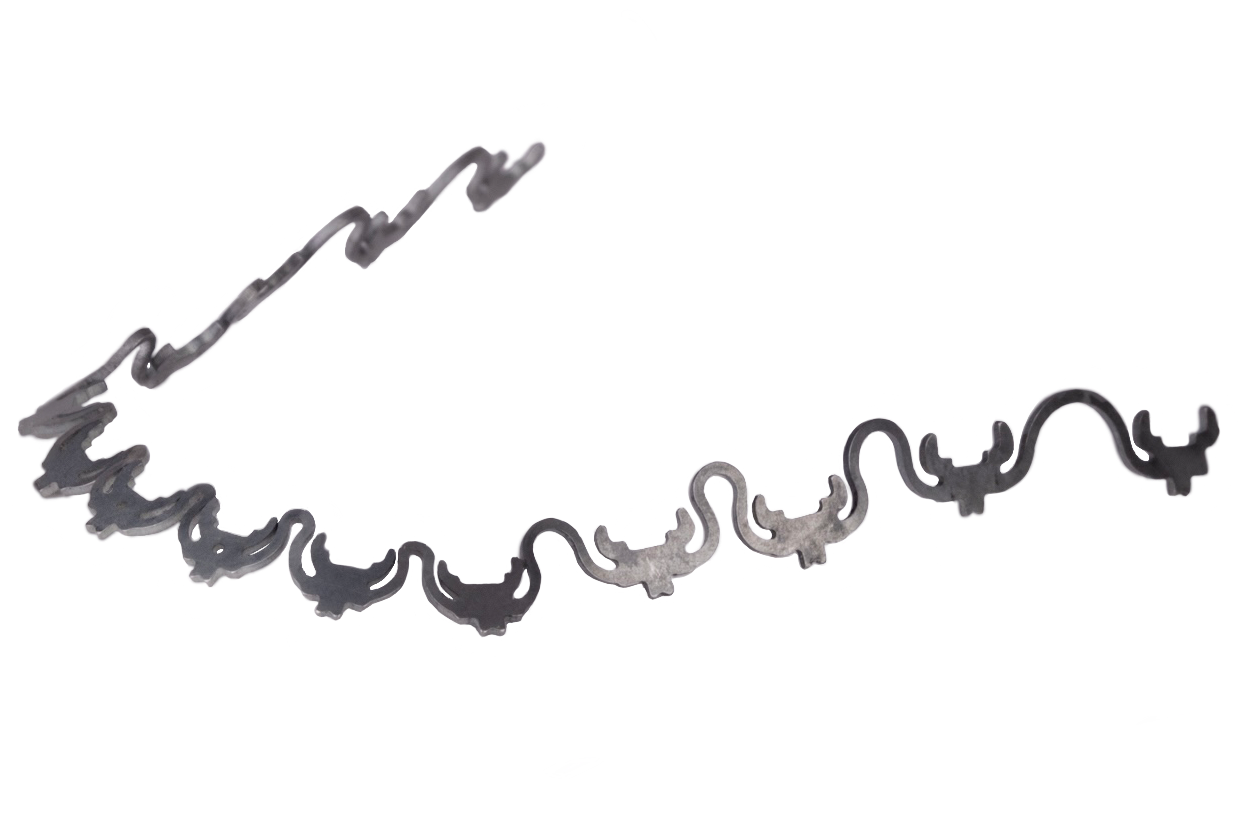
Unlike a traditional archwire, Smartwires have two alternating components: Lockets and Interproximal Loops. The Smartwire Locket was designed to engage and lock into the InSmile bracket which was designed specifically to work on the lingual (tongue-side) of the tooth rather than for the facial (cheek-side) of the tooth which a traditional archwire would look like for traditional braces. The Locket design makes it significantly easier for orthodontists to engage and disengage the Smartwire from the bracket compared to a traditional bracket which leads to greater adoption by orthodontists and increased access to lingual patient care. The shape of the Locket was designed to not only lock securely into the brackets but also support the programmed force delivery to the teeth. Some orthodontic assistants jokingly refer to it as a "Batman head" because of its distinctive shape.
The interproximal loops of the Smartwire have several important purposes.
Opening and Closing Spaces: One of the primary functions of the loops is space management. When crowding is present, the loops can help create the space needed for teeth to align properly. A rotated tooth, for example, often requires additional room before it can be fully corrected, and small spaces may temporarily appear during treatment as the teeth are repositioned.
The loops can also be designed to close spaces. In cases where gaps already exist, the loops may be manufactured in a smaller configuration and stretched slightly during insertion by your orthodontist. As the wire attempts to return to its original shape, light forces are generated that gradually close the spaces over time.
Increased Flexibility: The loops make the Smartwire more flexible, which helps orthodontists engage and disengage the wire more easily during appointments. Compared with some lingual systems that use stiffer wire designs, this flexibility makes the appliance easier to work with and more comfortable for patients.
Easier Flossing: Another benefit of the loop design is improved access for oral hygiene. Because the loop spans in between each tooth contact, patients are generally able to floss normally as if they did not have braces on. Maintaining good oral hygiene throughout treatment remains important, and the Smartwire design helps support that goal.
Orthodontic treatment is a process, not a single movement, and patients typically progress through a series of Smartwires that vary in size, stiffness, and force level. Treatment usually begins with smaller, more flexible wires that are easier to engage and better suited for the significant tooth movements that characterize the early stages of alignment. As treatment progresses, larger and stronger Smartwires may be used to provide the greater control and precision needed to finalize tooth positions and refine the bite. Each wire is selected based on the specific type of tooth movement needed at that stage of treatment.
After your first set of Smartwires, oftentimes additional sets of Smartwires are needed. One of the fascinating realities of orthodontics is that patients are biological humans, not computer simulations. Even with advanced digital treatment planning, teeth do not always move exactly as predicted. Some teeth respond faster than expected, while others may move more slowly. For this reason, orthodontists often obtain updated digital scans during treatment. These scans allow the treatment plan to be refined based on how the teeth have actually responded, and new Smartwires can then be designed using the updated tooth positions. Because the teeth are now much closer to the desired result, each subsequent set of Smartwires has less correction remaining to accomplish, allowing treatment to become increasingly precise as it progresses toward the finish.
From a patient's perspective, Smartwire change appointments are straightforward and relatively brief. When appropriate, your orthodontist or clinical team will remove the current Smartwire from the brackets, assess how your teeth have responded, and engage the next wire in the sequence. Most patients experience mild soreness for one to three days after a new wire is placed, as the teeth begin responding to the updated forces. This is entirely normal and the same sensation most orthodontic patients experience after any wire change. The appointments themselves are typically shorter than traditional brace adjustment visits, which is one of the practical advantages of a pre-programmed wire system.
Patients who have researched orthodontic options may notice a conceptual similarity between Smartwires and clear aligner trays: both are pre-programmed toward a planned final result using digital technology. However, how they deliver tooth movement is fundamentally different.
Clear aligners work through a series of removable plastic trays, each one moving teeth a small increment at a time. For aligners to work, they must be worn consistently for 20 to 22 hours per day. If trays are not worn as directed, tooth movement slows or stops entirely.
Smartwires, by contrast, are fixed to the teeth and work continuously. There are no trays to remove, no wear time to track, and no risk of treatment falling behind due to missed wear. The forces are delivered around the clock, regardless of what you are eating, doing, or whether you remembered to put something back in.
For patients who want the precision benefits of digital treatment planning without the compliance demands of removable aligners, the Smartwire approach offers a compelling alternative.
For patients, the practical result of all this technology is a treatment experience that is more efficient, more predictable, and more discreet than traditional orthodontic approaches.
Because much of the precision is built into the wire itself from the start, your orthodontist spends less time making manual adjustments at each appointment, which means shorter visits and fewer of them. Because the wires are customized to your treatment plan, tooth movement follows a deliberate, pre-planned path rather than being corrected incrementally by hand over many months. And because the entire system is designed to work on the hidden lingual surface of your teeth, all of this is happening in a way that no one around you can see.
Smartwire technology represents the intersection of digital planning and proven orthodontic science, and for patients seeking efficient, invisible treatment, it is what makes InSmile Braces truly special.