
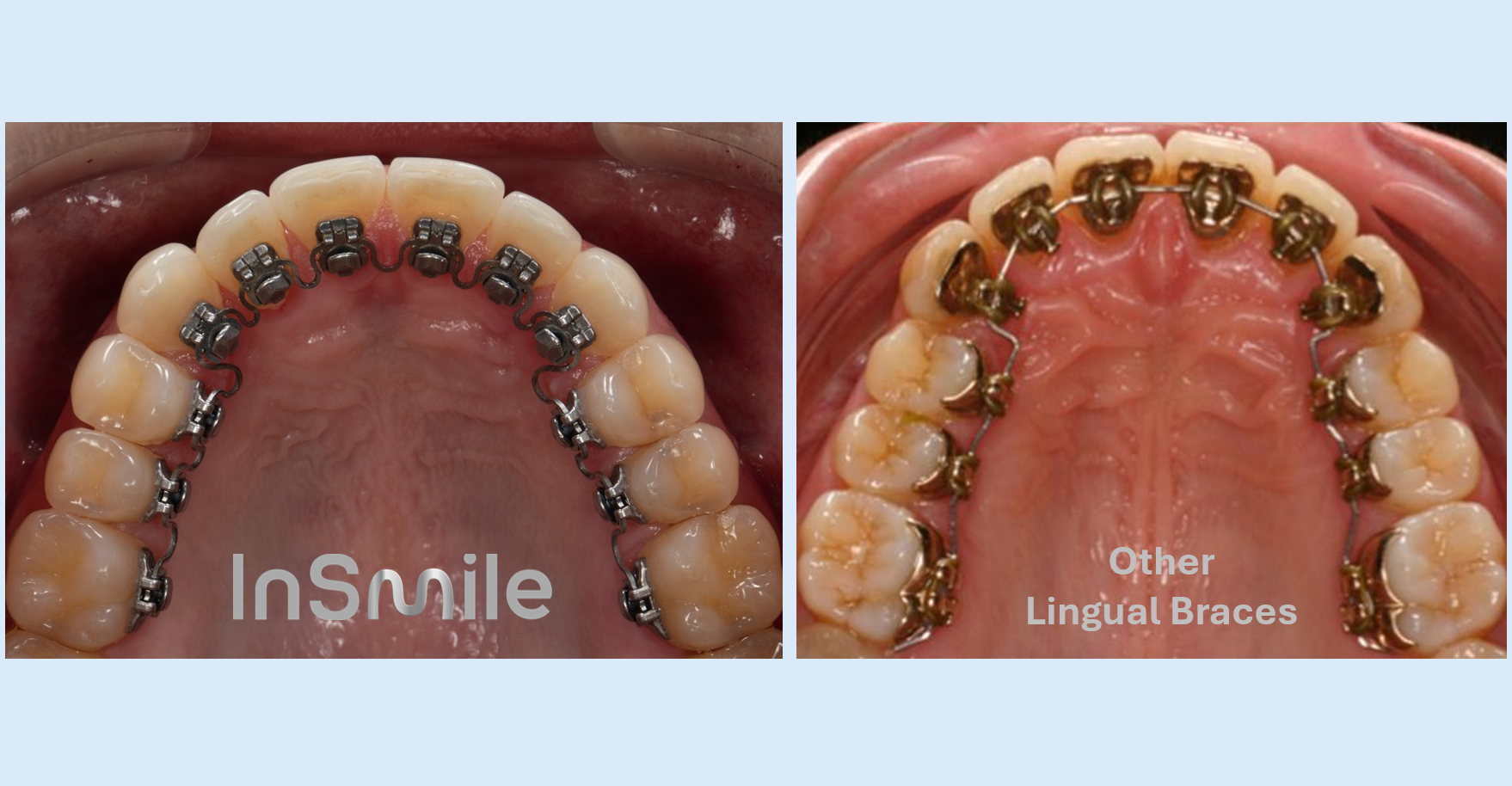
Lingual braces have one defining feature in common: the orthodontic appliance is placed behind the teeth instead of on the visible front surfaces. This allows patients to straighten their teeth with braces that remain largely hidden when they smile.
But not all lingual braces work the same way. Different lingual systems use different approaches to bracket design, wires, digital treatment planning, tooth movement, and clinical adjustments. Some closely resemble traditional braces moved to the back of the teeth, while others use customized components or alternative methods of delivering orthodontic forces.
InSmile Braces are a modern customized lingual braces system built around digital treatment planning and proprietary Smartwire technology. Understanding how that approach differs from other types of lingual braces can help patients have a more informed conversation with their orthodontist.
Traditional braces attach brackets and wires to the front surfaces of the teeth. Lingual braces move the appliance to the inside, or tongue side, of the teeth, which provides their most recognizable advantage: the braces are hidden behind your teeth. Like traditional braces, lingual braces are fixed appliances that remain attached throughout treatment, so patients do not need to remove them for meals or remember to wear them for a prescribed number of hours each day. Beyond those shared qualities, however, lingual systems can be quite different from one another.
Moving braces from the front of the teeth to the back creates unique orthodontic challenges. There is less working space behind the teeth, the distance between brackets is shorter, and accessing the brackets and wires during appointments can be more demanding. Lingual orthodontics therefore requires different approaches to appliance design and clinical treatment.
Over the years, manufacturers have developed several ways of addressing these challenges. Some lingual systems use an approach similar to traditional braces, with brackets connected by archwires that are changed or adjusted as treatment progresses. Other systems customize the brackets, wires, or both around the patient's individual treatment plan. Still others have redesigned how orthodontic forces are delivered altogether. InSmile belongs to this newer generation of customized lingual orthodontic systems.
The most distinctive difference is the Smartwire. InSmile does not simply take a conventional orthodontic archwire and move it behind the teeth. Instead, each patient's treatment is digitally planned, and customized brackets and Smartwires are designed around that treatment plan.
The Smartwire incorporates a series of interproximal loops between the teeth. These loops provide additional wire length and allow movements to be programmed into the appliance based on the patient's individual treatment plan. The nickel-titanium Smartwire uses shape-memory properties to deliver controlled orthodontic forces as it works toward its programmed shape. This creates a meaningfully different approach to lingual treatment compared with systems that depend more heavily on conventional archwire mechanics and repeated manual wire adjustments.
Another important feature of InSmile is that treatment begins digitally. Your orthodontist evaluates your teeth and bite and develops a treatment plan. A digital Smile Design is then created to define the planned tooth positions and bracket placement. Custom indirect bonding trays are manufactured so the brackets can be transferred to the planned locations behind your teeth, and your Smartwire sequence is designed specifically for your treatment.
Customization itself is not unique to InSmile, as some other modern lingual systems also customize brackets, wires, or other components. What distinguishes InSmile is how digital treatment planning, bracket positioning, and the Smartwire system work together as one integrated treatment platform.
Traditional fixed orthodontics often relies on the orthodontist changing wires, bending wires, adding auxiliaries, or making other adjustments as teeth move. Some lingual systems follow this same general philosophy behind the teeth. InSmile was designed to incorporate more of the planned tooth movement into the digital setup, bracket positions, and customized Smartwires before those components ever reach the patient's mouth.
This does not mean InSmile treatment never requires adjustments. Orthodontic treatment is biological, and teeth do not always move exactly as predicted. Your orthodontist still monitors progress and may modify treatment when necessary. The difference is that the InSmile system is designed to reduce reliance on some of the repetitive manual wire adjustments traditionally associated with lingual orthodontics.
One of the easiest ways to understand the difference between lingual systems is to look at the wire itself. Many fixed braces systems use relatively conventional continuous archwires that follow the dental arch. InSmile's Smartwire has a distinctive looped design. Those loops are not simply aesthetic. They provide additional wire length between adjacent brackets and are part of how the Smartwire delivers programmed forces to the teeth. The closed-loop design also helps keep wire ends contained as the teeth move, rather than leaving wire ends that may need to be clipped as treatment progresses.
For patients, the most obvious benefit is shared with all lingual braces: the appliance is hidden behind the teeth. The differences become more apparent in how treatment is delivered. InSmile combines a fixed appliance with customized digital treatment planning, indirect bracket placement, and patient-specific Smartwires. The system is designed to allow programmed tooth movement while reducing reliance on some conventional lingual wire mechanics. And because InSmile is a fixed appliance, treatment does not depend on remembering to wear removable trays. In addition, the looped wire design allows for patients to floss normally.
There are tradeoffs with every orthodontic appliance, and InSmile is no exception.
InSmile does not eliminate the normal adjustment period associated with lingual braces. Patients may initially notice tongue irritation, changes in speech, or greater awareness of the appliance. These effects generally improve as the mouth adapts, but individual experiences vary.
InSmile is also a specialized system that requires orthodontists and their teams to receive specific training in digital treatment planning, indirect bonding, Smartwire engagement, and treatment progression. Because not every orthodontist offers InSmile, patients in some areas may need to travel further to find a trained provider. An experienced lingual orthodontist using a different system may achieve excellent results using mechanics they know well, which is worth factoring into the conversation with your orthodontist.
There is no single lingual braces system that is best for every patient or every orthodontist. Different systems approach the challenges of lingual orthodontics in different ways, with some emphasizing conventional fixed-appliance mechanics, some using extensively customized components, and others using alternative mechanisms for individual tooth movement.
InSmile's approach centers on digital treatment planning, customized bracket placement, and proprietary Smartwire technology designed to program tooth movement while simplifying some aspects of traditional lingual mechanics. Whether that makes InSmile the right choice for you depends on your teeth, bite, treatment goals, and the recommendation of your orthodontist.
Absolutely. Lingual orthodontics is different from simply placing traditional braces behind the teeth. Diagnosis, treatment planning, bracket positioning, wire engagement, biomechanics, and troubleshooting all require appropriate training and experience. When considering lingual treatment, it's reasonable to ask your orthodontist how frequently they treat patients with lingual braces, how much experience they have with the system they're recommending, and whether they've treated cases similar to yours. With InSmile, every case is prescribed and supervised by a trained orthodontist throughout treatment.
Rather than focusing only on the name of an appliance, ask your orthodontist about the overall treatment experience. You may want to discuss how the appliance moves teeth, how customized your treatment will be, how often appointments are typically needed, how adjustments and refinements are handled, and what happens if your teeth don't move exactly according to the original plan. Most importantly, ask why your orthodontist believes a particular lingual system is appropriate for your specific teeth and bite. A good treatment recommendation should be based on your individual orthodontic needs, not simply the appliance itself.
Lingual braces have evolved considerably from simply placing conventional braces on the backs of the teeth. InSmile represents a modern approach built around customized digital treatment planning and Smartwire technology, with the goal of combining the discretion of braces hidden behind the teeth with a treatment system specifically engineered for modern lingual orthodontics.
If you're considering lingual braces, the best way to determine which treatment is right for you is to meet with an orthodontist who can evaluate your teeth, bite, and treatment goals.