
Not long ago, getting directions meant unfolding a paper map and figuring out the route yourself. Today, most people simply enter a destination into their GPS and receive a customized route designed to get them to their location as efficiently as possible.
Orthodontics has undergone a similar transformation. Traditional braces have helped millions of patients achieve beautiful smiles for decades. However, the treatment process has historically relied heavily on manual adjustments made throughout treatment. Modern digital treatment planning allows orthodontists to visualize the desired result before treatment even begins and create a customized roadmap to guide teeth toward that goal. This digital approach is one of the key technologies behind InSmile Braces.
For many years, orthodontic treatment followed a largely analog workflow. After braces were placed, orthodontists would typically begin treatment using standard nickel titanium (NiTi) wires. These stock wires are manufactured in standard arch shapes and are used to begin aligning the teeth. As treatment progressed, orthodontists would often transition to stainless steel wires that could be manually customized. Small bends would be placed into the wire to improve tooth positions, adjust the bite, close spaces, or correct individual teeth.
At each appointment, the orthodontist would evaluate how the teeth responded and decide whether to add more bends, reduce previous bends, introduce elastics or power chains, or make additional wire adjustments. This process has been used successfully for decades and remains effective today. However, much of the treatment planning occurs during treatment itself as the orthodontist continually evaluates progress and makes adjustments along the way.
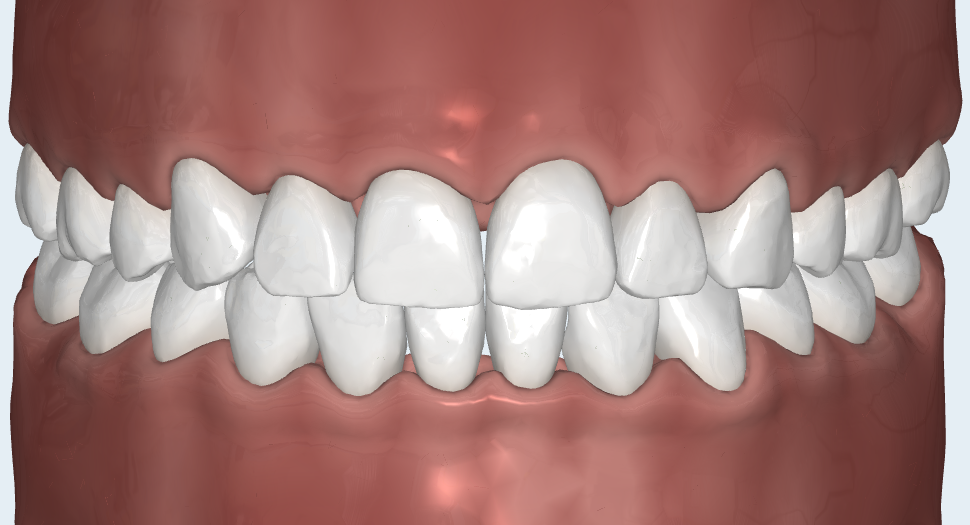
Just as technology has transformed navigation, photography, banking, and communication, it has also transformed orthodontics. Digital treatment planning allows orthodontists to plan the destination before treatment begins. Instead of relying primarily on adjustments made throughout treatment, orthodontists can use advanced software to create a digital simulation of the desired result, visualizing where the teeth are today, where they should be at the end of treatment, and how to get from one position to the other.
The difference is similar to a paper map versus a GPS. A paper map can still get you to your destination. A GPS, however, provides a customized route based on your specific starting point and desired destination. Digital orthodontics applies the same concept to tooth movement.
The foundation of InSmile digital treatment planning is the digital intraoral scan. Using a small handheld wand called an intraoral scanner, your orthodontist captures a precise 3D model of your teeth in just a few minutes.
For patients who have had orthodontic treatment in the past, this is a significant improvement over traditional impressions. There is no goopy material to bite into, no trays to hold in place, and no uncomfortable waiting while impressions set. The scanner simply moves around the inside of your mouth and generates an accurate digital model almost immediately.
The resulting 3D scan gives your orthodontist an exact representation of your current tooth positions, which becomes the starting point for your entire digital treatment plan.
Once the digital scan is complete, your orthodontist uses specialized InSmile software to virtually move your teeth into their ideal positions. This creates a complete digital simulation of your planned result before a single bracket is placed.
The digital setup allows your orthodontist to customize every aspect of your treatment, including tooth alignment, smile width, individual tooth positioning, bite relationships, and space closure or opening. Rather than simply reacting to tooth movement throughout treatment, your orthodontist begins with a clear and approved vision of the desired outcome.
Once the digital treatment plan is finalized, customized InSmile Smartwires are designed and manufactured to help guide your teeth toward those planned positions.
One of the biggest advantages of digital treatment planning is that it allows orthodontists to think through the entire treatment process from the very beginning. Traditional orthodontic wires primarily focus on initial alignment, with additional mechanics introduced later in treatment to accomplish more specific movements. For example, space closure may require the addition of power chains after the teeth have already begun aligning.
With InSmile Braces, many different tooth movements can be incorporated into the treatment plan from the start. Because the Smartwires are designed based on the digital setup, they can be programmed to perform multiple types of tooth movement simultaneously, including aligning crowded teeth, rotating teeth, managing spaces, coordinating arch forms, and refining individual tooth positions. This allows the treatment system to work toward the final objective from the very beginning rather than waiting for later stages of treatment.
Every smile is unique, and one of the most powerful aspects of digital treatment planning is the ability to customize treatment for the individual patient. Orthodontists are not simply straightening teeth; they are designing smiles.
Using digital treatment planning software, orthodontists can make precise adjustments to tooth positions and smile aesthetics before treatment begins. This creates an opportunity for thoughtful, deliberate planning and helps ensure that the final result reflects both the orthodontist's clinical goals and the patient's expectations. In many ways, digital treatment planning allows orthodontists to become architects of the smile before construction even starts.
One question patients often ask is: if everything is planned digitally, why would new Smartwires ever be needed?
The answer is that people are biological systems, not robots. Even the most sophisticated treatment plan cannot perfectly predict how every tooth will respond. Some teeth move faster than expected, while others move more slowly. Individual differences in biology, bone remodeling, tooth anatomy, and patient response can all influence treatment progress.
Because of this, orthodontists often obtain updated digital scans during treatment. These scans provide an opportunity to compare the planned movements with the actual movements that have occurred. If necessary, a new digital treatment plan can be created based on the current tooth positions, and updated Smartwires can then be manufactured to continue guiding the teeth toward the final result.
Think about using a GPS during a long road trip. Even if the route is carefully planned, traffic, road construction, or detours may require adjustments along the way. The GPS simply recalculates and creates a new route from your current location.
Digital orthodontics works similarly. As treatment progresses and the teeth move closer to their desired positions, updated treatment plans can be created using the latest scans. Because the remaining tooth movements are smaller at each refinement stage, each subsequent plan becomes increasingly precise. This process allows orthodontists to continuously improve accuracy while working steadily toward the planned result.
For you as a patient, digital treatment planning means that your orthodontist arrives at your first appointment with a plan, not just a starting point. Your treatment has a clearly defined destination, a customized pathway to get there, and the flexibility to be refined along the way as your teeth respond.
The practical benefits are meaningful. Treatment tends to be more efficient because many tooth movements are addressed simultaneously from the start rather than sequentially over time. Results tend to be more predictable because the Smartwires are engineered around your specific plan rather than adjusted by hand at each visit. And because the entire system works on the hidden lingual surface of your teeth, your treatment remains completely invisible throughout the process.
Traditional orthodontics relies heavily on stock wires and manual adjustments made throughout treatment. InSmile Braces combines modern digital treatment planning with customized Smartwire technology to create a more individualized approach, one designed around your smile and your treatment goals from the very beginning.