
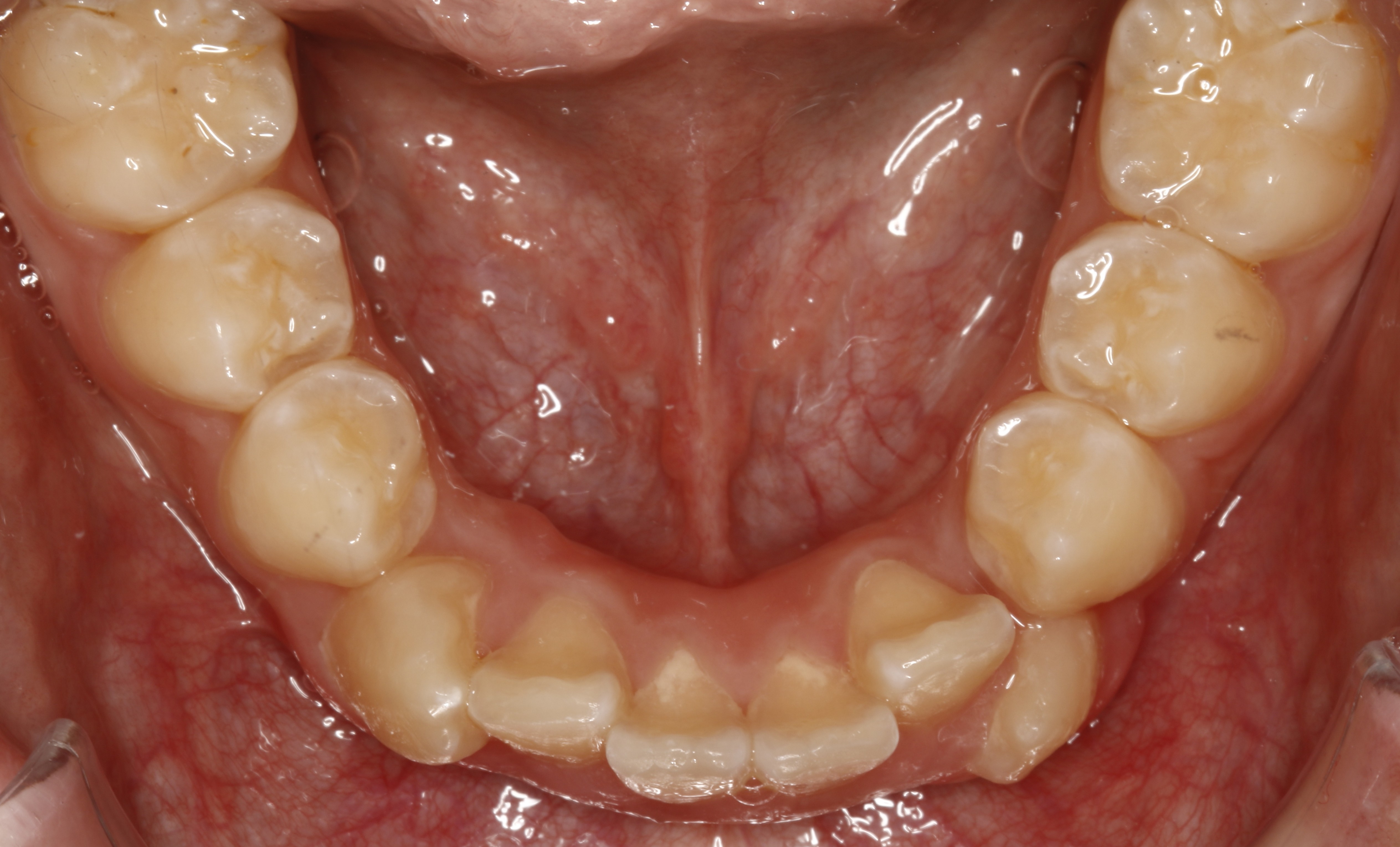
Crowded teeth are one of the most common reasons people seek orthodontic treatment. Whether it's one tooth that overlaps another or an entire smile that appears crooked, crowding affects both the appearance of your smile and your oral health. Crowded teeth can be more difficult to clean, increase the risk of cavities and gum disease, and sometimes contribute to bite problems.
The good news is that modern lingual braces, including InSmile Braces, are highly effective at treating crowded teeth, from mild cases involving a single overlapping tooth to some of the most complex orthodontic presentations.
In orthodontics, crowding occurs when there isn't enough room in the jaw to properly accommodate all of the teeth. Imagine trying to fit ten books onto a shelf that's only large enough to hold eight: some books would overlap, rotate, or stick out because there simply isn't enough space. Teeth behave the same way. When there isn't enough room, they may overlap one another, rotate out of position, become pushed toward the front or back of the dental arch, or erupt in abnormal positions. The amount of crowding varies significantly from patient to patient, which is why orthodontists classify it into different levels of severity.
Mild crowding involves only a small amount of overlap. Patients may notice one or two slightly crooked teeth while the rest of the smile appears relatively straight. These cases often require only a modest amount of space to achieve excellent alignment.
Moderate crowding involves multiple teeth that overlap or rotate. Creating additional space becomes a more important part of treatment, and your orthodontist may consider several different approaches depending on your bite and smile goals.
Severe crowding occurs when there is a significant shortage of space. Several teeth may overlap extensively, rotate out of position, or erupt outside the normal dental arch. Although these cases are more complex, modern orthodontic techniques can often achieve excellent results with careful treatment planning.
One of the biggest misconceptions about orthodontics is that teeth are simply "straightened." In reality, orthodontists spend much of their time determining how to create enough space for the teeth to fit properly. There are three primary ways this can be accomplished.
1. Expansion: One approach is to make the dental arch slightly wider. Expanding or broadening the arch creates additional room for crowded teeth while also improving smile width in many patients. Depending on the patient's anatomy and treatment goals, this may involve true arch expansion, controlled tooth movement, or a combination of both.
2. Interproximal Reduction (IPR): Another option is a procedure called interproximal reduction, often referred to as IPR. During IPR, your orthodontist gently removes a very small amount of enamel between selected teeth. Because only fractions of a millimeter are removed from each tooth, the combined effect can create several millimeters of additional space while preserving a natural appearance. IPR is a safe, common orthodontic procedure and is frequently used in the treatment of mild to moderate crowding.
3. Tooth Extractions: For patients with more significant crowding, removing one or more teeth may provide the space needed to achieve a healthy bite and balanced facial appearance. While many patients hope to avoid extractions, they are sometimes the most appropriate treatment option depending on the amount of crowding, the bite relationship, and overall treatment goals. Your orthodontist will discuss all available options before making any recommendations.
Modern lingual braces are capable of treating mild, moderate, and severe crowding. Just like traditional braces, lingual braces can be used alongside arch expansion, interproximal reduction, or tooth extractions when needed. The choice of space-creation method depends less on the type of braces being used and more on the individual patient's smile, bite, facial structure, and treatment goals.
One of the most complex tooth movements in orthodontics is correcting severe rotations. Think about sliding a chair across a room. Moving it in a straight line is relatively straightforward, but now imagine trying to rotate that same chair while simultaneously moving it across the floor. That combined movement is far more complex, and the same principle applies to teeth. Rotating a tooth requires carefully controlled forces and enough space for the tooth to untwist into its proper position, which is one reason severely crowded cases can be more technically demanding than they first appear.
One aspect of treating crowded teeth that patients sometimes find surprising is that spaces may temporarily open between teeth during the early stages of treatment. This is completely normal and not a sign that something is going wrong. When crowded or rotated teeth begin to align, they first need room to move, and that room often appears as temporary spacing before the teeth settle into their final positions. Your orthodontist will monitor this throughout treatment and close any remaining spaces as part of the finishing process.
One of the strengths of InSmile Braces is the combination of customized digital treatment planning and individualized Smartwires. Unlike traditional orthodontic wires that begin as standard stock arch forms, InSmile Smartwires are custom designed around your orthodontist's digital treatment plan, which means each wire is programmed specifically for your planned tooth movements from the very beginning.
The flexibility built into the Smartwire design allows it to deliver gentle, continuous forces while helping manage rotations and space throughout treatment. The interproximal loops incorporated into the wire can help create space when crowding is present, close unwanted gaps, and allow patients to maintain more normal flossing habits throughout treatment. These features make InSmile Braces particularly well suited for resolving crowded and rotated teeth while keeping the entire treatment completely hidden behind your teeth.
Traditional braces, clear aligners, and lingual braces are all capable of successfully treating crowded teeth. The best treatment depends on your specific case and your orthodontist's clinical recommendation. In some situations, clear aligners may require additional attachments, refinement rounds, or longer treatment timelines to achieve certain types of tooth movement, particularly when significant rotations are involved. Because InSmile Braces are a fixed appliance with customized Smartwires, they can provide excellent control for complex tooth movements while remaining completely hidden behind the teeth throughout treatment.
There is no single solution that works best for every patient. Some patients benefit from expansion, others are excellent candidates for IPR, and more severe cases may require extractions to create enough room for ideal alignment. The role of your orthodontist is to evaluate your teeth, bite, facial structure, and treatment goals before recommending the approach that will provide the healthiest and most stable long-term result.
If you're considering hidden braces for crowded teeth, an experienced InSmile provider can determine whether lingual braces are the right option for your smile and develop a customized treatment plan designed specifically for you.