
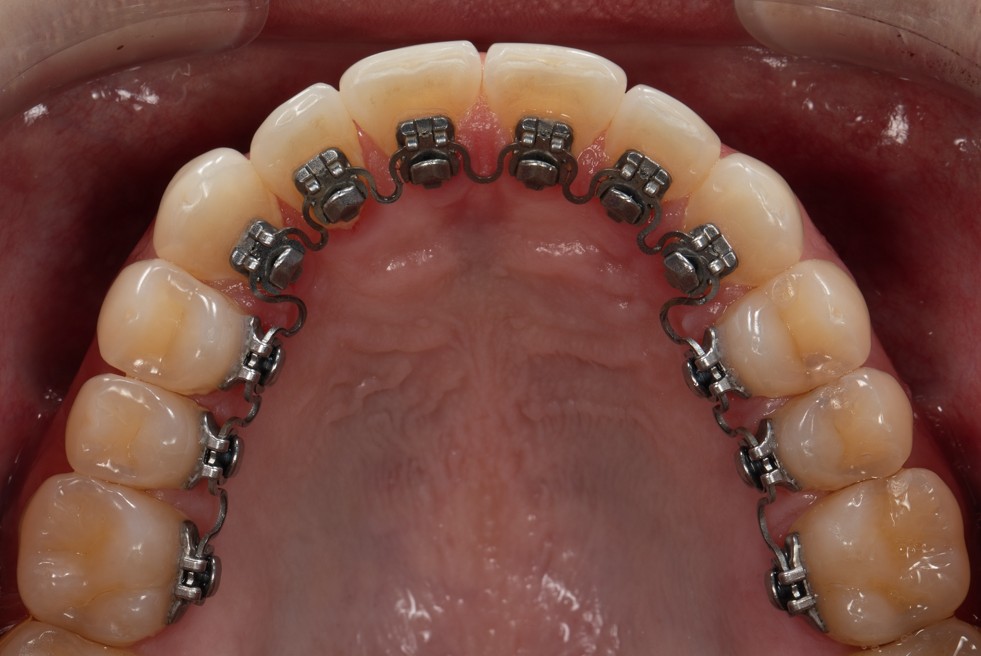
If you've ever wanted straighter teeth but hesitated because you didn't want visible braces or removable aligners, lingual braces may be the solution you've been looking for. Lingual braces are often called "hidden braces" because they are placed behind your teeth, making them virtually invisible when you smile, talk, or laugh. Unlike clear aligners (e.g., Invisalign®), lingual braces work around the clock and do not depend on patient compliance. Unlike traditional braces, which are placed visibly on the front side of your teeth, lingual braces remain completely hidden from view. For adults, professionals, and teens who want an effective orthodontic treatment without drawing attention to their smile, lingual braces offer a unique combination of aesthetics, convenience, and predictable results. In this guide, we'll explain what lingual braces are, how they work, who they're for, and why modern lingual systems like InSmile Braces are helping more patients than ever choose hidden orthodontic treatment.
Lingual braces are a type of orthodontic appliance that uses brackets and wires to move teeth into their ideal positions, similar to traditional braces that sit on the front side of your teeth. The key difference is that the brackets for lingual braces are attached to the inside surfaces of the teeth, facing the tongue, rather than the outside surfaces that are visible when you smile.
The word "lingual" comes from the Latin word for tongue, "lingua," which refers to the tongue side of the teeth, where the braces are positioned. Because the braces are hidden behind the teeth, most people will never know you're undergoing orthodontic treatment unless you tell them. From the outside, your smile looks completely natural.
Lingual braces work using the same proven biological principles as traditional braces, except that the forces driving tooth movement come from the back side of the teeth instead of the front. The mechanism of force delivery is identical: brackets are attached to each tooth, an orthodontic wire is engaged into those brackets, and as the wire attempts to return to its designed shape, controlled forces are delivered to the teeth, gradually moving them into alignment.
Just as technology has advanced from analog to digital systems in most fields, modern lingual braces have become highly customized using digital scans, 3D treatment planning, and custom manufacturing. This allows orthodontists to precisely design how each tooth will move throughout treatment and has made today's lingual braces significantly more efficient than earlier generations of hidden braces.
Completely Hidden: The most obvious benefit of lingual braces is aesthetics. Since lingual braces are placed behind the teeth, they are virtually invisible during everyday interactions. Whether you're giving a presentation, attending a meeting, taking photos, or speaking with clients, your orthodontic treatment remains discreet.
Always Working: Unlike clear aligners such as Invisalign, which are removable and don’t work when they aren’t worn, lingual braces are fixed to the teeth, so they are working 24 hours a day. There is nothing to remove, nothing to remember, and nothing to lose. Because treatment does not depend on wearing trays for 20 to 22 hours per day, tooth movement remains consistent and predictable.
Effective for Most Orthodontic Problems: As a fixed orthodontic treatment system, lingual braces can treat many of the same complex orthodontic issues as traditional braces, including cases that clear aligners may struggle with.
Customized Treatment: All patients’ teeth are different. Modern lingual systems are designed specifically for each individual patient, allowing orthodontists to create highly customized treatment plans based on the unique characteristics of their smile.
Initial Speech Changes: During the first one to two weeks, some patients notice temporary changes in speech, particularly with "s" and "th" sounds. Most patients adapt quickly as their tongue learns to move around the braces. It’s worth noting that most patients also experience initial speech changes with clear aligners.
Tongue Irritation: Because the brackets are located near the tongue, mild irritation can occur during the initial adjustment period. This typically improves significantly after the first few weeks. Most patients also experience some initial discomfort with clear aligners and traditional braces during this adjustment period.
Cost: Lingual braces are often more expensive than traditional braces because of the customization, technology, and expertise involved. However, many patients feel the added discretion and convenience are worth the investment.
Provider Availability: Not every orthodontist offers lingual braces, so it may be difficult to find a provider in your area, which could mean a longer commute to receive lingual treatment.
Lingual braces are especially popular among the following groups.
Adults: Many adults want straighter teeth but prefer not to wear visible braces during professional or social interactions. Lingual braces allow adults to improve their smile while maintaining a natural appearance throughout treatment.
Professionals: Doctors, attorneys, executives, teachers, sales professionals, and public-facing individuals often choose lingual braces because they can undergo treatment without affecting their appearance and without the hassle of taking in and out clear aligner trays.
Teenagers: Many teens appreciate the ability to straighten their teeth without visible braces during their high school years, school pictures, and school events like dances and graduation.
Patients Seeking a Compliance-Free Option: Some patients struggle with clear aligners because they are removable and forget to wear them consistently. Lingual braces eliminate this concern because they remain attached to the teeth throughout treatment, so they are always working.
Many patients are surprised to learn that lingual braces can treat far more than simple cosmetic alignment concerns. Depending on the individual case, lingual braces can be used to address:
An orthodontic consultation is the best way to determine whether lingual braces are appropriate for your specific situation.
Not all lingual brace systems are the same. Early versions of lingual braces met limited success due to poor bracket design, which simply took traditional brackets designed for the front of teeth and adapted them to the back, along with the added complexity of working with the more irregularly shaped inner surfaces of the teeth. Later lingual systems like WIN and Incognito, which have incorporated some customizations and updated bracket designs, made meaningful improvements, but many orthodontists still find them difficult to incorporate into practice due to the added complexity relative to traditional braces, so adoption among orthodontists has remained marginal, which limits patient access to lingual orthodontic care. InSmile Braces was designed differently, with a reconceived bracket design and workflow to significantly simplify the clinical technique without compromising results, making it easier for orthodontists to offer lingual treatment and ultimately meaning more patients can access hidden orthodontic treatment.
InSmile Braces represent a modern approach to lingual orthodontic treatment, built on the advantages that earlier lingual systems provided while solving the pain points they introduced. InSmile Braces reconceptualized the entire bracket and wire design to work specifically on the lingual surface and make the system easy for orthodontists to use, which significantly increases the likelihood of adoption and ultimately provides greater access to lingual orthodontic care for prospective patients. InSmile also uses custom Smartwire technology where all tooth movement is programmed through advanced digital smile design and treatment planning, which resolved many of the difficulties orthodontists experienced during treatment due to the irregular lingual surfaces they were unfamiliar working with. Furthermore, the InSmile Smartwire allows patients to floss easily, whereas flossing is difficult with other lingual systems, which supports better oral hygiene throughout treatment. Through the combination of novel brackets, wires, and digital programming, InSmile Braces provides efficient, predictable tooth movement while maintaining the aesthetic advantages that make lingual braces so appealing.
Treatment time depends on the complexity of your case. Orthodontic treatment broadly ranges from as little as 6 months for simple cases to 36 months for more complex ones, with the average falling between 12 and 18 months across all treatment modalities. This range exists because there is a biological limit to how quickly teeth can be moved safely, regardless of the appliance used.
What sets customized lingual treatment apart is not speed, but efficiency. Because the entire treatment is digitally mapped from start to finish, similar to how GPS plots the most direct route to a destination, tooth movement follows a precise, pre-planned path. Traditional analog treatment, by contrast, often involves mid-course corrections and adjustments along the way. This means lingual treatment with InSmile Braces does not necessarily move teeth faster, but it can move them more efficiently, which may reduce overall treatment time by a few months compared to less precise approaches.
Your orthodontist can provide a personalized estimate after reviewing your records and treatment goals.
The cost of lingual braces varies depending on several factors, including case complexity, treatment duration, geographic location, and the lingual system used.
Many lingual systems carry higher fees because working with the irregular anatomy of the inner tooth surfaces requires significantly more chairside time and technical effort from the orthodontist. This added complexity is passed on to the patient in the form of higher treatment costs. InSmile Braces was designed to change this. By simplifying the clinical workflow and reducing the chairside burden on the orthodontist, InSmile allows providers to offer lingual treatment at a price point more comparable to comprehensive clear aligner therapy, making hidden orthodontic treatment more accessible than it has historically been.
That said, lingual braces will generally be priced at a modest premium over traditional braces, reflecting the customization and technology involved. Many orthodontic practices offer financing options and payment plans to help make treatment affordable, and some dental insurance plans provide partial coverage for orthodontic treatment regardless of the appliance type. The best way to get an accurate cost estimate is to schedule a consultation with an InSmile Braces provider, where your orthodontist can review your specific case and provide a personalized quote.
When it comes to orthodontic treatment, the three main options are lingual braces, traditional braces, and clear aligners. Each has its pros and cons, and every patient has their own preferences. The main factors to consider are predictability of treatment outcomes, treatment time, visibility, compliance, and the adjustment period. Adults and teenagers may prioritize different aspects, but if you're looking for treatment that is invisible and doesn't depend on patient compliance, lingual braces may be right for you.
The best way to find out is to schedule a consultation with an experienced InSmile Braces provider near you.
Are lingual braces the same as Invisalign?
No. Lingual braces are fixed brackets and wires placed on the back of the teeth. Invisalign is a series of removable clear plastic trays worn over the teeth. Both are discreet options, but they work differently. Lingual braces are always working and don't depend on patient compliance, while aligners require consistent daily wear.
Do lingual braces hurt more than regular braces?
Initial tooth movement soreness is similar to traditional braces. The primary adjustment for lingual braces is tongue sensitivity and mild speech changes in the first week or two. Most patients report that after the initial adaptation period, they become used to the braces quickly, and some describe forgetting they're even wearing them.
Can I see lingual braces when someone smiles?
No. When properly placed, lingual braces are not visible from the front or side. When you smile, speak, or laugh, nothing is visible on the front surfaces of your teeth.
Does every orthodontist offer lingual braces?
No, not every orthodontist offers lingual braces. For an orthodontist to offer lingual braces, they need to sign up to become a provider with one of the lingual orthodontic companies. To find a trained InSmile Braces provider near you, use the InSmile Orthodontist Finder.
What happens after treatment?
At the end of treatment, your orthodontist removes the lingual braces and fits you with a custom retainer to maintain your new smile. Retention is a lifelong commitment and wearing your retainer as directed by your orthodontist is the only way to ensure your results last.